Fundamentals of Mixing
Fundamentals of Mixing
Cocktail mixing techniques are fairly basic. Where technique gets complicated is in making it look effortless and cool. In a professional setting, bartenders have to handle multiple orders, conversations, an organized station, make drinks quickly, and make everything look easy. But if you're like me and just making drinks at home, then you really don't have to care about all that. You will, however, have to learn some basic techniques.
All mixing techniques incorporate the ingredients of a drink. They also deliver three main objectives: aeration, chilling, and dilution. These three variables are what defines mixed drinks and cocktails from the rest of the world of drinks. Diluting your barrel-proof Bourbon with water does not make it a cocktail, nor does chilling your vodka for a luge or carbonating your fermented wort. Cocktails and mixed drinks combine all three.
Let's take some time to identify the mixing techniques and their high level differences.
The Four Core Techniques
Stir
Ingredients and ice are placed in a vessel within which they are swiftly stirred together for 45-60 seconds.
Shake
Ingredients are placed in a shaking vessel and shaken for 12-15 seconds with ice.
Blend
Ingredients are rapidly incorporated with an electric blender for 10 seconds or until smooth.
Build
Ingredients are added to a serving vessel, typically with ice, and incorporated with a brief stir.
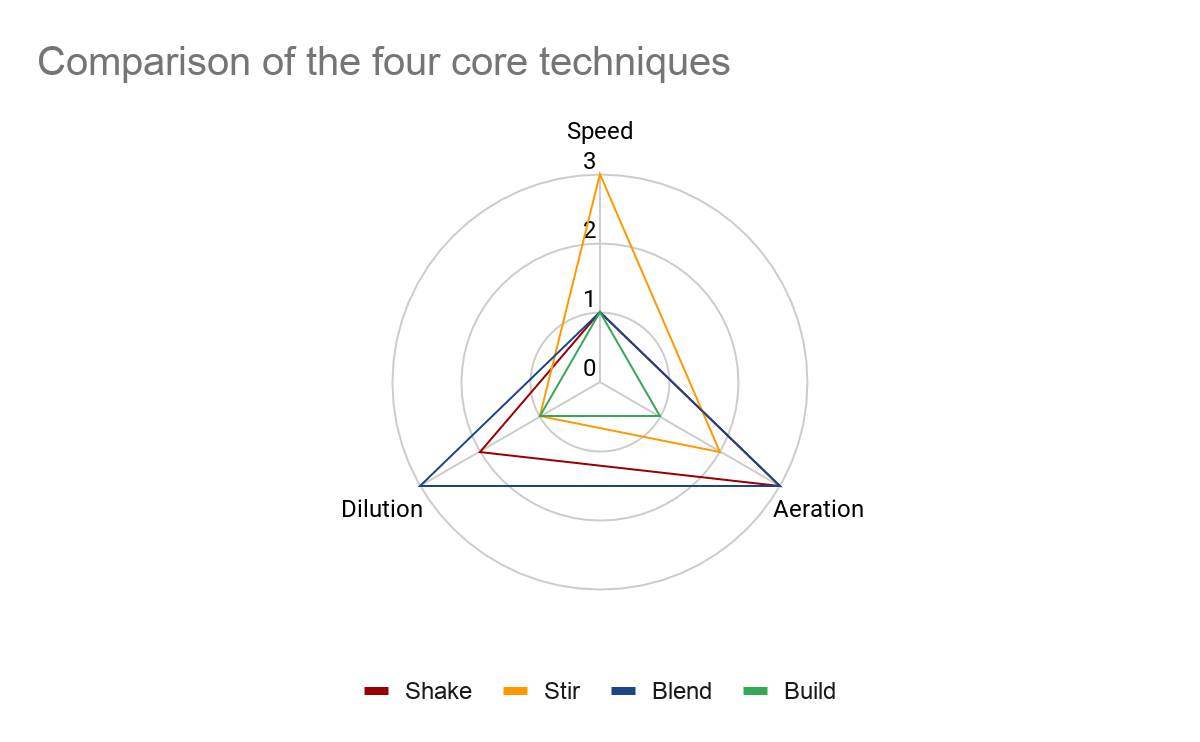
The chart above compares each mixing technique and how they perform for each of the mixing objectives. As you get better, try adapting different techniques to recipes. Swapping out a mixing technique can help you highlight different aspects of a drink. Or maybe you don't like the loud noise of a blender - try shaking with crushed ice instead!
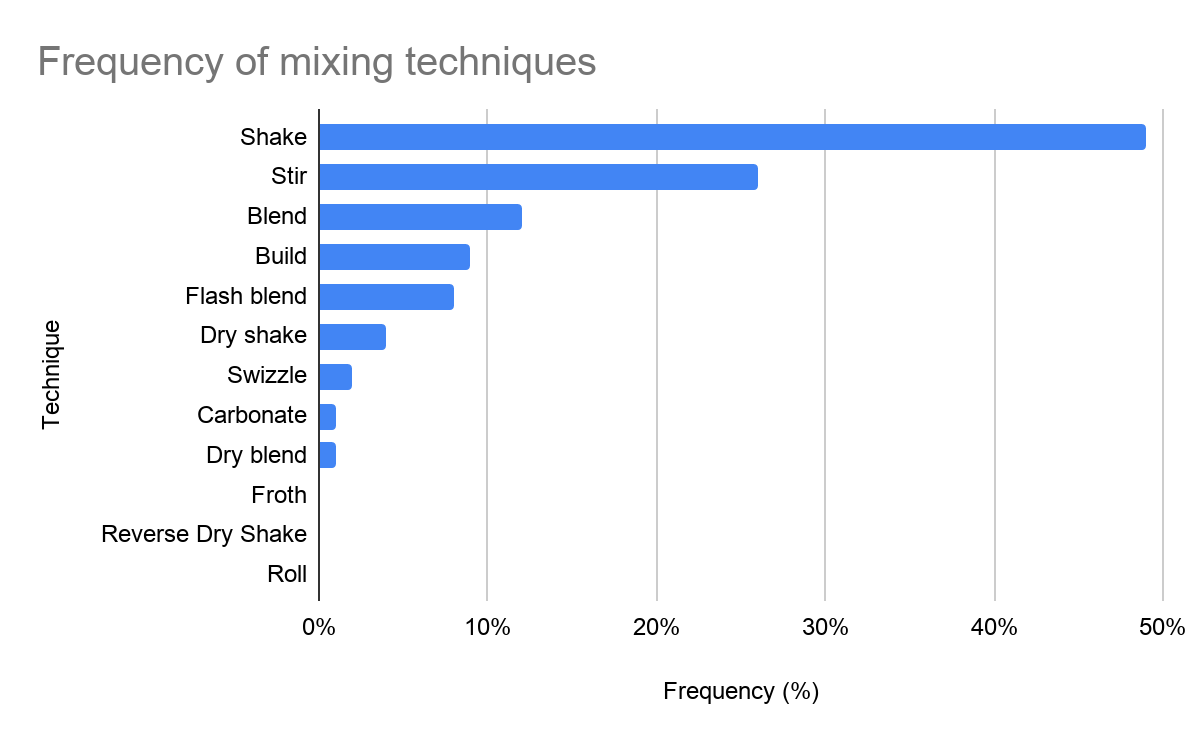
The four core mixing techniques presented above are the most used, based on the data behind all the recipes in Tipply. There are additional techniques which are used far less. With Tipply, techniques and processes are presented in a very structured way, again, based on the data for how great cocktails are made. The chart below depicts both this (the process order) and the number of recipes which use those techniques.
Less Common Techniques
In addition to the five core techniques, there are some less common techniques you should be aware of. Some of these are variants of the core techniques, while others are animals unto themselves.
Flash Blend
Ingredients are rapidly incorporated with an electric blender for no more than 5 seconds.
Dry Shake
Ingredients are shaken without ice for 15 seconds or longer so that a foam can be created before shaking with ice.
Swizzle
Ingredients are added to a tall serving vessel with cracked or crushed ice, then swiftly agitated with a swizzle stick or barspoon.
Dry Blend
Ingredients (excluding egg white) are rapidly incorporated with an electric blender until smooth, then strained.
Roll
Ingredients are mixed by pouring them between two mixing vessels, one with ice.
Carbonation
Ingredients are force carbonated.
Froth
With your mixed ingredients, then strain into your serving vessel. Then use an electric frothing wand to rapidly add texture and foam to your cocktail.
Reverse Dry Shake
Ingredients are shaken with ice, strained, and then shaken without ice for 15 seconds or longer so that a foam can be created.
More can be learned about the techniques, but this should get you started with understanding the terms and a little of the theory behind cocktail aeration, chilling, and dilution. You can explore each technique more by reviewing their separate articles. Another good starting point is to pick a technique you want to get good at and make some cocktails! You can use the list below to go immediately to a filtered set of recipes that use a particular technique.